Annual General Meeting 2026
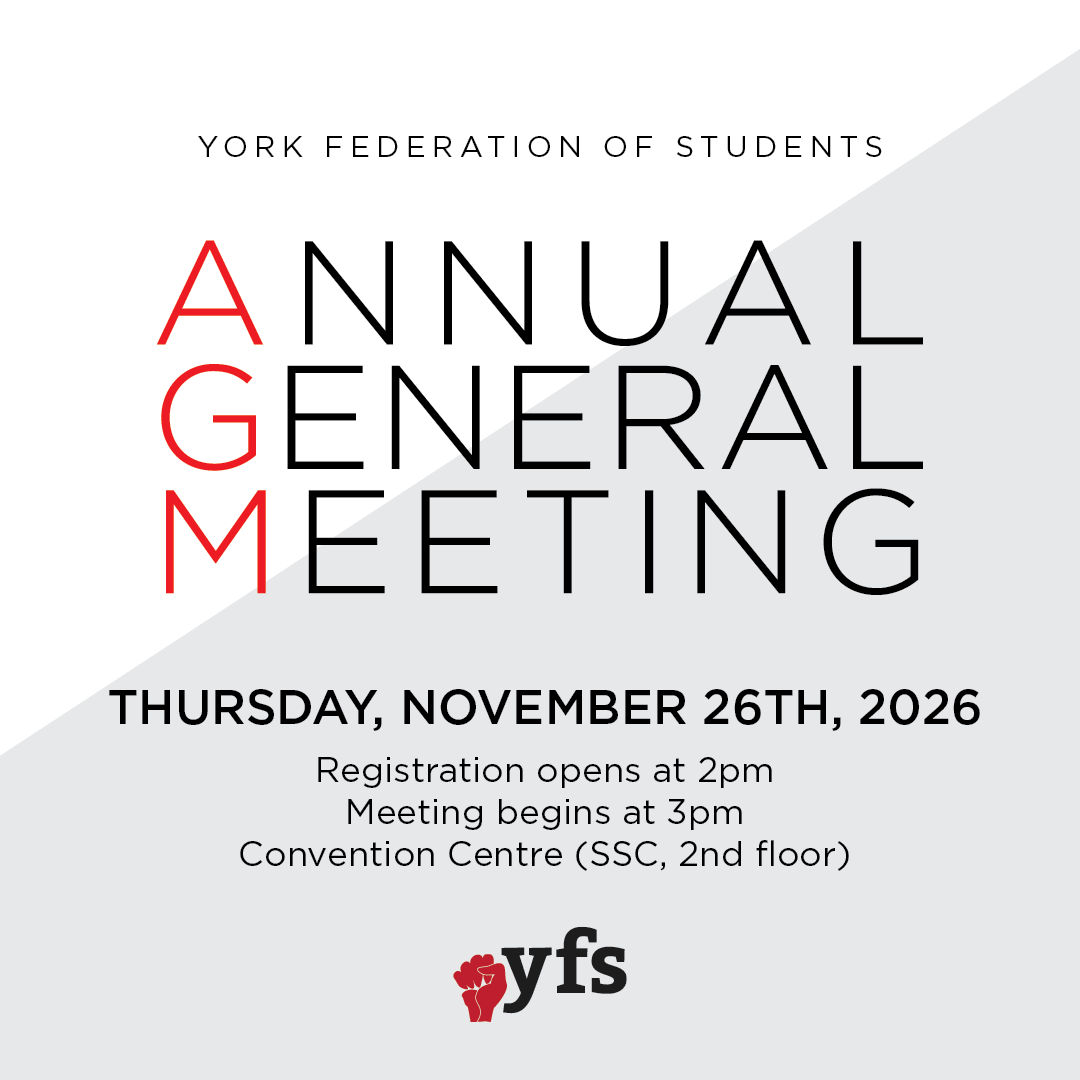
Join us on Thursday, November 26th at 3:00pm in the Convention Centre (Second Student Centre, 2nd floor) for the YFS Annual General Meeting! The Annual General Meeting happens every year, and provides members with the opportunity to receive updates from their elected representatives, in addition to submitting and voting on motions that help determine the direction and stances that their Students' Union takes.
In order to enter, please bring your YU student card. The Annual General Meeting is only open to current members of the York Federation of Students.
Motions can be submitted to president@yfs.ca by Thursday, November 12th at 4:00pm.
Proxies may also be submitted via the form at the bottom of the page by Thursday, November 19th at 4:00pm.
If you have any questions or concerns about the AGM, or would like to identify accessibility needs, please contact Symone Lennon at president@yfs.ca.
MEETING DOCUMENTS
Documents marked by an asterisk (*) will be available on or after November 19th.
Meeting Resources
Supplementary resources you may find helpful when navigating the AGM.
Frequently Asked Questions
-
Through consultations with legal counsel, the YFS Board of Directors has gained a more thorough understanding of their legal and fiduciary responsibilities as officers of the Federation under the requirements of the Ontario Not-for-Profit Corporations Act, and has adjusted the language used to explain the rights and responsibilities of members who attend the Annual General Meeting to better reflect best practices under these Articles.
Every Director of the Federation (inclusive of Executives, College, and Faculty Directors) is required by law to act honestly and in good faith with a view to the best interests of the corporation (ONCA, Part IV, s. 43 (1)(a)). Likewise, no provision in the articles, by-laws, or resolutions passed at meetings of the members relieve a director or officer from the duty to act in accordance with the ONCA or relieves them from liability for a breach of this Act or the regulations (ONCA, Part IV, s. 43 (3)).
Meaning, a YFS Director who mechanically implements a YFS Member resolution on a management matter, without turning their mind to whether that course of action is in fact in the best interests of the Federation, has not exercised the independent judgment that their duties demand. If YFS Directors treat Member resolutions as automatically binding and implement the results of these resolutions without independent analysis, the YFS Directors are vulnerable to allegations that they failed to comply with their personal duties and are liable for any consequences thereof. This is why motions, regardless of outcome, are still required to be discussed and voted upon at a Board of Directors meeting after the AGM concludes.
Resolutions discussed and voted upon at the AGM can serve as evidence of Member views which, in turn, can form part of the factors considered by the YFS Board when assessing what is in YFS’ best interests. The will of the membership is, and always has been, a vested priority of the YFS Board of Directors. The YFS is a student federation, therefore the interests of Members are highly relevant to determining what is in the Federation’s best interests. -
While management decisions regarding the day-to-day affairs of the Federation are outside of the purview of Members, under the YFS By-laws and ONCA, Members still retain a defined set of rights and responsibilities.
Non-exhaustively, Members influence the Federation’s direction by electing YFS Directors whom they trust to manage its affairs wisely, by removing YFS Directors who fail to do so (ONCA, Part IV, s. 26 (1)), and by exercising their approval rights over fundamental changes and By-laws (ONCA, Part III, s. 17 (2)(6) & ONCA, Part XII, s. 136 (c)). What Members cannot do, as a general matter, is dictate governance or operational decisions to the Board directly. Their influence over such matters is properly exercised indirectly, through the election and removal of the YFS Directors who make those decisions. -
At the AGM, important procedural requirements under the law are presented and voted on. The ONCA requires the presentation and approval of audited financial statements (ONCA Part VII, s. 77, 78 and Part VIII, s. 84).
Beyond that, the AGM is an important step in expressing the will of the membership to the Board and serves as a vital stepping stone in their decision making processes. It is an extremely valuable procedure of the union, and provides a democratic forum in which members can formally speak to their elected representatives and express the direction they hope to see the union follow. The YFS is committed to remaining transparent with its members about its decision-making processes and outcomes. -
The meeting will be held in-person at the Convention Centre (Second Student Centre).
Registration opens at 2pm and the meeting starts at 3pm. We recommend members arrive as early as possible to cut down on wait times and to ensure the meeting can begin on time.
When registering for the meeting, bring your YU student card. Check out the FAQ section “What do I need to attend the AGM?” for what to bring if you don’t have a YU card.
Once registered, you’ll be given a voting card that you’ll need to hold onto throughout the meeting. Head inside, grab some free pizza, and wait for the meeting to begin!
The meeting will begin at 3pm and once quorum is reached.
-
You just need to bring your YU student card! We accept physical or digital copies.
If you don’t have your YU card, we’ll ask you to do two things: log into your Passport York and show us a valid government-issued ID.
Acceptable IDs include:Ontario Driver’s Licence
Passport
Canadian Citizenship Card
Canadian Armed Forces Card
Bring Your Identification (BYID) card issued by the LCBO
Secure Indian Status Card (Canadian)
Permanent Resident Card (Canadian)
Any photo card issued under the Photo Card Act 2008
-
The YFS AGM is open to all YFS Members. According to the YFS By-laws (2.1b), “All registered undergraduate students at York University shall be deemed to be members of the Federation.”
For greater clarity, this does not include Seneca College students, Osgoode students, students in the School of Continuing Studies, graduate students, or staff or community members of York University who are not current undergraduate students. -
We recommend reviewing the meeting documents and resources that are linked above. Some paper copies will be available at the YFS office (FSC 336) ahead of the meeting, or at the door on the day of the AGM for accessibility purposes. To reduce excessive printing, we recommend using digital copies for your personal use.
Glossary
Proxy
A “proxy” is a means by which a member who expects to be absent from a meeting authorizes someone else to act in their place at the meeting. Source
Principal
A member who designates their vote to a proxy, to act and vote on their behalf. Source
Quorum
A quorum refers to the minimum number of group or organization members that must be present for official business to be carried out. This minimum number is usually set by the organization’s bylaws. Source.
According to the YFS By-law (9g), “Two Hundred Fifty (250) members present either in person or by proxy shall form a quorum at the annual, or any other meetings of the members of the Federation.”
Chair
An impartial person who uses and enforces parliamentary procedure (in this case, Robert’s Rules of Order) to help the assembly make decisions in a fair and efficient manner.
ONCA
The Ontario Not-for-Profit Corporations Act (ONCA) provides Ontario not-for-profit corporations, including charitable corporations, with a modern legal framework to meet the needs of today’s not-for-profit sector. It sets out how not-for-profit corporations are created, governed and dissolved. Source
Submitting Motions
After a multi-year legal review of the Federation’s by-laws and their compliance with the Ontario Not-for-Profit Corporations Act (ONCA), the procedural capacity of the Annual General Meeting (AGM) has changed.
What stays the same:
Motions can be submitted for consideration ahead of the AGM, following appropriate guidelines.
Motions can be voted on, amended, and passed, failed, or deferred at the AGM.
Germane discussions around each motion’s topic can take place.
What changes:
All motions regardless of their result will be brought to the next meeting of the Board of Directors where a final vote will take place to decide the outcome of the motion.
Due to the legal and fiduciary duties that the Board of Directors hold as officers of the organization, they have the responsibility to make decisions that are in the overall best interest of the Federation. The meeting of the Board after the AGM is intended to allow the Board adequate time to research and consult on the legalities of each motion, while balancing their responsibility to their membership and their duty to the health of the organization.
The AGM is an important step in expressing the will of the membership to the Board and serves as a vital stepping stone in their decision making processes. It is an extremely valuable procedure of the union, and provides a democratic forum in which members can formally speak to their elected representatives and express the direction they hope to see the union follow. The YFS is committed to remaining transparent with its members about its decision-making processes and outcomes.
Any member (an undergraduate student of York University) may submit a motion. In order to be considered, motions must be received by the President via email to president@yfs.ca no later than Thursday, November 12th at 4:00pm. Motions can be put forward to create issues policies, standing resolutions, or campaigns, among other things.
Motions cannot be submitted by fax or mail.
Motions submitted in accordance with the by-laws will be circulated to members in the AGM Package, which will be distributed no less than 1 week before the Annual General Meeting at which they are to be considered.
Proxy Form
The deadline to submit a proxy form has now passed.
A proxy form can be used in the case that you cannot attend the AGM, but still wish to provide your permission for the meeting to continue in your absence. By providing a proxy, you are also giving permission to the proxy holder to vote on your behalf. One member cannot hold more than 3 proxies.